
Purpose
IV Rank answers whether options on this name are expensive or cheap for this name, as a 0 to 100 score against its own trailing year.
An absolute implied-volatility number cannot tell you that. Forty percent is cheap on one symbol and rich on another, and comparing the two tells you about the companies rather than about the options. A rank removes the symbol from the question.
The term lane answers a different one: whether the cost of options is concentrated into the near dates, which is what an event priced to a specific day looks like.
Best used for:
- Choosing between buying and selling premium, before choosing a structure.
- Comparing option richness across names that trade at completely different volatilities.
- Finding event risk the headlines have not mentioned yet, through a positive term spread.
- Timing: entering premium sales when a name's own options are near the top of their range.
What you see on the chart
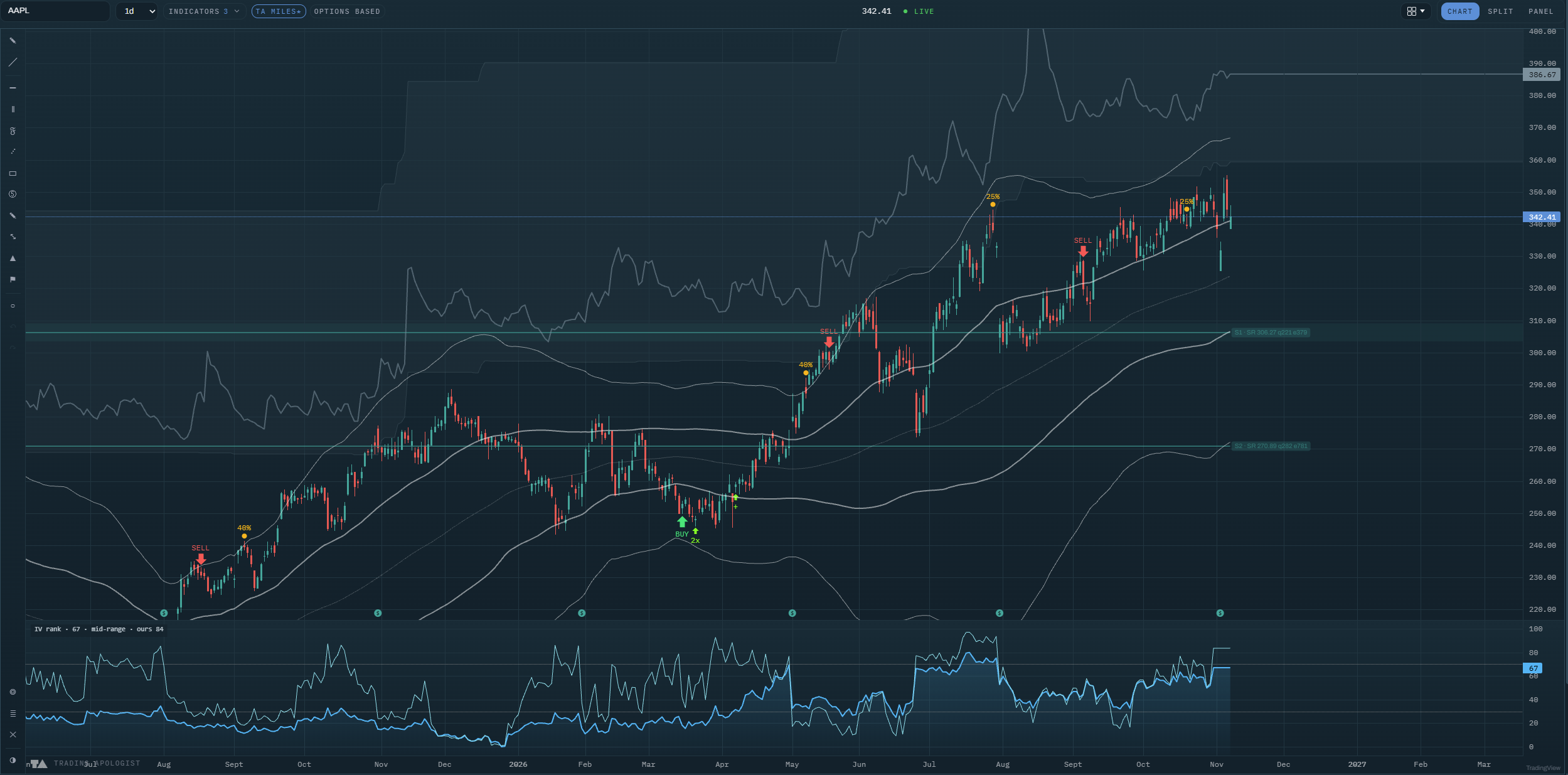
A pane below price, drawn as an area from the floor rather than a line, because a rank is a magnitude measured up from zero rather than a signal oscillating around a centre.
- The rank lane: today's implied volatility placed in its own one-year range, 0 to 100.
- A second, lighter line: the same ranking computed independently, as a cross-check. When the two agree you can lean on the reading.
- Rich and cheap guides: horizontal references at 70 and 30. Above 70 this name's options are expensive by its own standards; below 30 they are cheap.
- A legend: the current rank in words, for example "IV rank · 67 · mid-range".
How to read it
- Above 70, you are being paid well to be short premium. Credit spreads, covered calls and cash-secured puts all improve when the rank is high, because you are selling into this name's own expensive end.
- Below 30, long premium gets cheap. Debit spreads and long options cost less than they usually do on this name, which matters most ahead of a catalyst.
- Mid-range is genuinely neutral. Between 30 and 70 there is no volatility edge in either direction, and the trade should rest on something else.
- A rank near 100 is not a sell signal. Volatility can stay expensive for weeks, and high rank often coincides with real risk. It prices the premium, not the direction.
- Switch to the term lane for event risk. A positive front-minus-back spread means the near expiry costs more than the far one, which is how the market prices a dated event. A negative spread is the normal, calm shape.
How the engine works
The rank places today's implied volatility inside the range the same symbol has traded over the trailing year: zero is its cheapest, one hundred its most expensive. The second line applies the same ranking independently so a bad reading shows up as disagreement rather than as a confident wrong answer.
The term lane subtracts back-expiry implied volatility from the front, so an event concentrated in the near dates reads positive.
Honest limitation: a rank needs history to rank against. On the most actively traded names that history is deep; outside that set the pane says it has nothing stored for the symbol rather than drawing a line it cannot justify. The term lane needs the most history of all and is the last to fill in.
Key settings
- Lane:
rankorterm spread. The pane switches between the two readings. - IV rank: the main lane, with colour, width and line style.
- Our percentile: the independent cross-check line, on or off.
- Rich / cheap guides: the 70 and 30 references, on or off.
- Term spread: the front-minus-back lane and its zero line.
Availability
US equities with a listed options chain, daily and weekly charts. Not available on pairs or crypto charts. Coverage is deepest on the most actively traded names. Included from the Pro plan up.
IV Rank and Term Structure is an AI Trading Desk indicator. See it on a live chart in the AI Trading Desk, or browseevery guide.
Educational and analysis purposes only. Not financial advice. See theterms.