
Purpose
Options Flow shows premium arriving by side, bar by bar, through the session: where the money went and when.
It answers a different question from Net Premium Flow. That one is a slow cumulative read over months; this is the intraday detail, so you can see a burst of premium land against the bar it landed on. A companion gutter puts the same premium by strike against the price axis, because a strike is a price, and "the market is paying up at the 347.5 calls" is a price-located fact that belongs on a price chart.
Best used for:
- Timing: seeing exactly which bar a positioning event arrived on.
- Confirming a breakout with the premium that accompanied it.
- Finding the strike the money is concentrating at, which is often where price gets pulled.
- Distinguishing a move that was paid for from one that drifted.
What you see on the chart
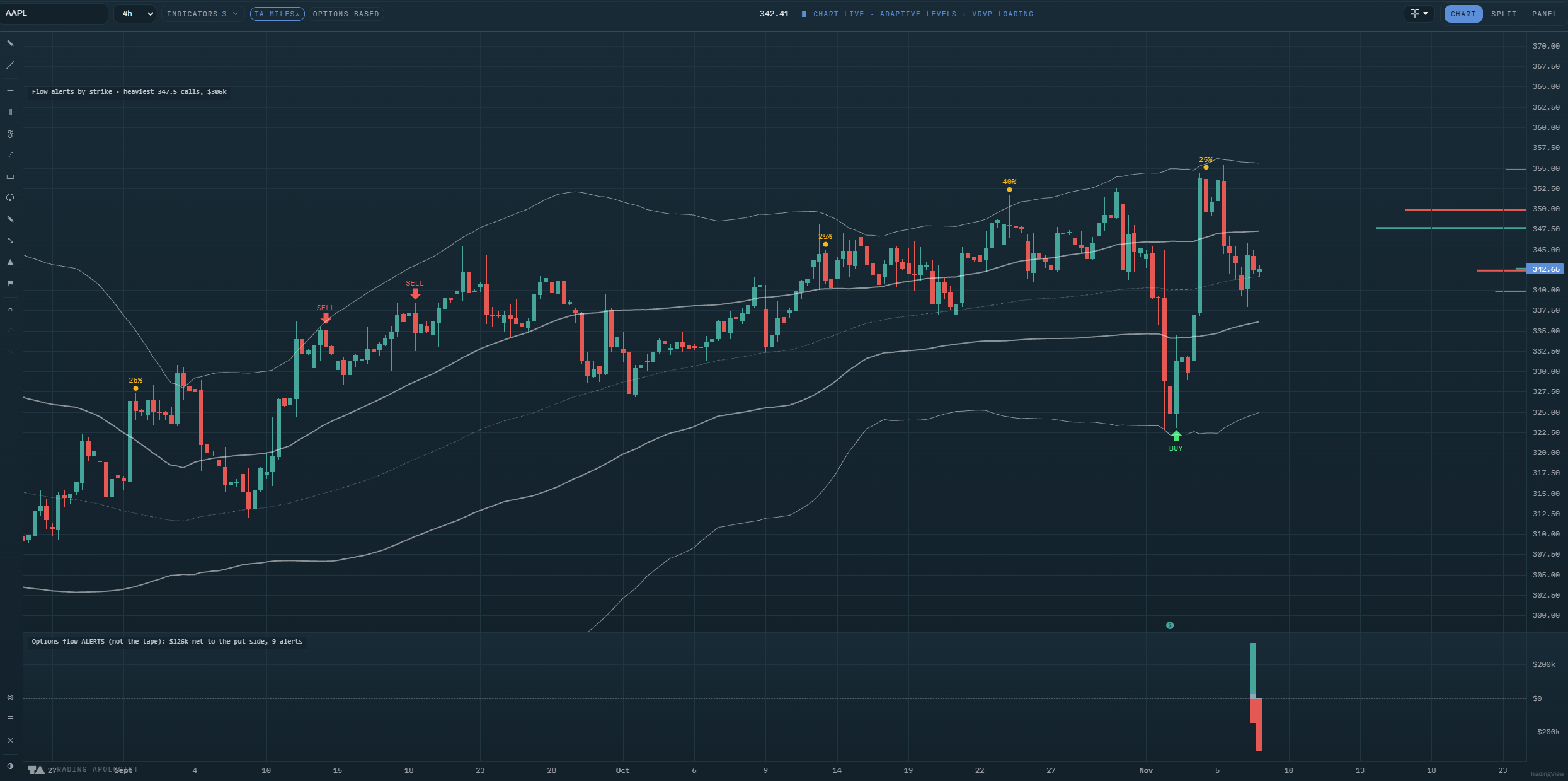
A pane below price, with premium split by side per bar:
- Calls lifted draws one way: premium that paid the ask on calls, or hit the bid on puts.
- Puts lifted draws the other: the mirror of that, because buying a put is the bearish act.
- No side: premium that crossed at neither the bid nor the ask. It carries no directional information and is never counted as if it did.
The legend states the net for the window and the number of alerts behind it, for example "Options flow ALERTS (not the tape): $126k net to the put side, 9 alerts".
A gutter on the price pane shows the same premium grouped by strike, anchored at the right edge, with the heaviest strike named: "Flow alerts by strike · heaviest 347.5 calls, $306k".
How to read it
- A tall bar is a positioning event, not a trend. Someone committed meaningful premium in that bar. Check which side, then check whether price confirmed it over the following bars.
- A flat bar means no alert fired, not that nothing traded. This is the most important sentence on the pane and it is written on the canvas for that reason.
- Use the strike gutter for the level, the pane for the timing. Together they answer "when did the money arrive, and at what price did it want exposure".
- Mid premium is not a vote. Premium that crossed between the quotes tells you size without telling you intent. Treat a bar that is mostly mid as activity without direction.
- Sides are about who was aggressive. The split is taken from which side of the spread each trade paid, so it reflects urgency rather than opinion. An aggressive buyer of puts is bearish regardless of what they say.
How the engine works
This reads an alert feed, not the whole options tape. It captures trades that met a size or unusualness threshold, which is a deliberately filtered view: the point is to surface the trades worth noticing rather than every print.
Premium is additive, so a bar on any timeframe is simply the sum of the buckets inside it, and no second request is needed when you change timeframe. Bars with no coverage are absent rather than drawn as zero, so a gap reads as a gap.
The side convention comes from which side of the spread each alert paid, applied per alert and then summed. The mapping inverts for puts, which is why an aggressive put buyer counts as bearish.
Honest limitation: a filtered feed is not the market. Absence of alerts is not absence of trading, and a quiet pane means the threshold was not met. The store keeps a few sessions of history, so the pane is restricted to intraday timeframes. A daily chart over it would be three bars, which is why it does not offer one.
Key settings
- Calls lifted and Puts lifted: the two directional bars, each with its own colour and transparency.
- No side: the non-directional portion, on or off.
- Strike gutter: the price-pane profile, with a width control.
Availability
US equities with a listed options chain, intraday timeframes only, on the most actively tracked names. Not available on pairs or crypto charts. Included from the Pro plan up.
Options Flow (Alerts) is an AI Trading Desk indicator. See it on a live chart in the AI Trading Desk, or browseevery guide.
Educational and analysis purposes only. Not financial advice. See theterms.